Video Project Communication: 7 Mistakes That Slow Down Collaboration with an Agency (and How to Avoid Them)
Communication
·
Content & Production
·
·
6 min

Vague briefs, delayed approvals, unexpected costs – the most common source of these problems is precisely communication. Even seemingly small mistakes in information exchange can paralyze the entire postproduction process and cause frustration on both sides.
Does it always have to be this way? Absolutely not!
Below you will find a list of the 7 most common communication pitfalls that slow down a project and strain relationships. By avoiding them, you stand a chance for a smooth, efficient, and successful collaboration, resulting in a video exactly as you wanted to make it.
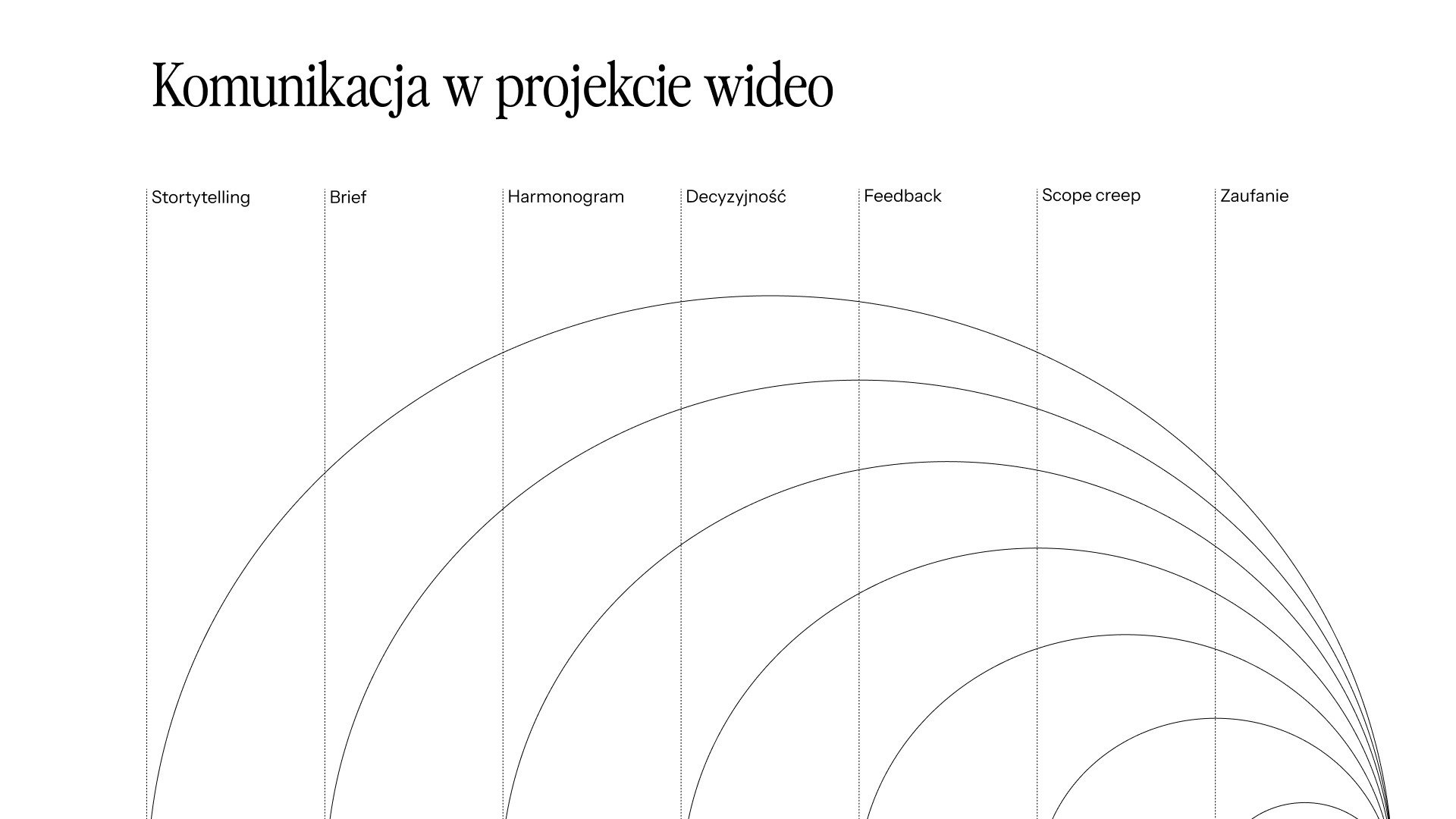
1. Storytelling? No, thank you, I have data, tables, and charts
Statistics, tables, charts – if you think about advertising in terms of "the more facts, the better," then... not quite. Data is a great foundation, but it rarely builds understandable and engaging material on its own.
If you decide to use only dry facts, your video might lack a clear plot. The message becomes disrupted, viewers are overwhelmed, and in the worst case, the material is not very understandable. Hard data itself rarely captivates an audience.
How to avoid this?
Define goals and create a compelling narrative.
Organize the video, dividing it into a classic structure: beginning, middle, and end.
Focus on emotional engagement instead of too many details.
Develop the script together to ensure that a well-told story carries the right message, backed by your substantive data. A good story makes the video more impactful and memorable.

2. Vague or incomplete brief
A poorly defined brief is a direct path to chaos and misunderstandings. The agency may interpret your needs differently than you intended, leading to solutions that do not fit your vision. The consequences are multiple revisions, wasted time, and increased costs.
Important: If you don't know something or are unsure – state it in the brief. It is better to know what we don't know than to make wrong assumptions.
How to avoid this?
If possible, ask someone to review the document before sending it.
Inform about what is not certain or finalized.
Share your concerns and ideas. Ask questions.
Include references (examples of videos you like or dislike).

3. Ignoring the schedule and delays in feedback
The postproduction process is linear and structured. It must follow a timeline because individual phases follow one another. The estimate and schedule are the two most important documents that are consulted and approved by the client.
The schedule contains information on when files will be sent for review and by when they must be evaluated. If approvals are delayed, it creates a domino effect – reducing the time for subsequent work or, in the worst case, affecting the final deadline.
Creative process vs. time
Postproduction is also a technical and creative process. Sometimes something that seemed perfect on paper does not work in practice, requiring a new solution. In projects with tight schedules (e.g., in advertising), materials are sent ongoingly, and reviewing them as quickly as possible is crucial.
How to avoid this?
If you know you will be unavailable on a given day, inform about it and designate a deputy.
Treat material evaluation as a priority. The faster you speak up, the faster changes will be implemented and you will receive the next version.
4. Lack of a single contact and decision-making person
When several people on the client's side contact the agency, often without coordination, chaos arises. A typical scenario of such a communication breakdown looks like this: the agency sends a draft version to 5 people, and in return receives 5 separate, contradictory feedbacks. Instead of implementing revisions, the agency has to consolidate and clarify comments, while time flies and the deadline approaches.
What can you do?
Assign one main contact person who consolidates all internal feedback and communicates exclusively with the agency.
Put one person in CC in emails, who can efficiently take over communication if needed.
If you do not have a single decision-maker and agree on feedback together – do not wait for absent people if it risks the deadline for sending comments.
Avoid long email exchanges. If possible, meet and review and evaluate new materials together on the spot.
5. Vague or unsubstantiated feedback
In the creative process, every comment is valuable – even the smallest one. Sometimes, however, it happens that comments relate to elements that will only appear at a later stage (e.g., coloring, effects, details), or are very general, like "it's not quite there yet." In such situations, the agency may have difficulty precisely reading expectations – and that is completely normal.
Responses like: "I imagined it differently" or "I don't like it" do not give the agency any guidance on what to improve. This leads to guessing, unnecessary revisions, and frustration. The vaguer the information, the longer the revision process takes.
What can you do?
Use tools (e.g., Frame.io): such platforms allow you to stop the video on a specific frame, add a marker, a comment, and even draw something on the frame. Your comments are visible in real-time to everyone, and the revision history is in one place.
If you work manually, be detailed: use timestamps (e.g., 00:02:15:20) so that the agency can quickly locate the problem.
Justify your comments: if you write why you want to change the text color, the agency will better understand your intention and propose the optimal solution.
If you don't know what is not working, ask for a meeting: a quick call is most effective in terms of time and budget.
6. Scope change in the middle of the project (scope creep)
It is normal for new ideas, needs, or formats to emerge during work. The creative process is alive – it changes, evolves, and sometimes opens up new possibilities that no one thought of at the start.
The problem only arises when additional elements are expected to be created within the same timeframe and original budget – which is not always technically possible. Not because "it can't be done," but because time, resources, and people need to be properly planned for many stages of production and postproduction.
How to manage this?
Already at the beginning of the project, it is worth describing what is to be created as accurately as possible – this facilitates planning.
If a new idea comes up along the way, it can be treated as a project expansion – with a new schedule and estimate.
Thanks to this, the main project is not threatened, and additional materials are created in an organized and stress-free manner.
You gain full control over the process and the assurance that everything will be done at the highest level.
Such an approach allows the project to develop without chaos and unnecessary pressure – while remaining open to good ideas that are born during the work.
Example of scope creep: After a shoot for a 16:9 commercial, the client asks to additionally deliver 9:16 and 1:1 versions within the same budget and deadline. Such "add-ons" disrupt established processes, increase costs, and pose a real threat to the deadline.

7. When it is hard to trust the process
In creative projects, it is natural for the client to want to have control – after all, it is their brand, their product, and their responsibility. Strong commitment is good, as long as it does not turn into micromanagement, which usually harms more than it helps.
Agencies work with various specialists – directors, editors, camera operators, motion designers. They have proven processes and experience that allow them to achieve the best result. Sometimes, however, excessive control or rejecting experts' recommendations can unnecessarily complicate the project.
How to find the perfect balance?
Treat the process as a collaboration, not as one-sided supervision.
Share your vision, but also give space to the specialists.
If a recommendation raises doubts – ask for justification instead of rejecting it right away.
Remember that the agency and the client share a common goal: the best possible final result.
Building mutual trust works in favor of both sides – the results are better, the process is calmer, and the final video or campaign is more consistent with your strategy.