A man destined for success, or what impact does advertising have on men?
Communication
·
Media
·
·
4 min


Advertising, like media as a whole, has a huge impact on how we perceive masculinity and femininity. There is more and more talk about femvertising – campaigns that challenge stereotypes about women. And what if we started a discussion about something that could be called menvertising?
This word is not yet commonly used in marketing, although it could be understood analogously to femvertising – as advertising activities challenging rigid patterns of masculinity and freeing men from the roles imposed on them. What stereotypical images of men circulate in advertisements and which campaigns are starting to challenge these patterns? The process of creating a communication platform from the perspective of the creative department.
Dominant models of masculinity
In culture, gender roles are sometimes uneven. A man in an advertisement is usually shown as strong, competent, emotionally distant – and in various commercials, several recurring patterns can be distinguished.
The first of them exposes the male body: a muscular torso, sweat, often a half-naked silhouette and an accompanying desiring woman – a typical image in advertisements for perfumes, clothing or underwear. Therefore, not only women are idealized in advertisements; men are also sometimes depicted in an unrealistic way.
The second pattern is the successful man: a self-confident leader, with a high income, a car and an elegant house. This pattern often appears in advertisements for alcohol, luxury goods, the automotive industry or financial services.
The third model is a man who copes with everything – a handyman, a practical expert, confident in solving problems; such an image appears in advertisements for tools or cars. At the same time, advertisements (e.g. some pharmaceutical commercials) can show men as clumsy "mamas' boys", which is a different stereotype.
It is also worth remembering that the image is not created only in advertisements directed directly to men. When we see recurring, stereotypical female roles in commercials addressed to women, certain default assumptions regarding the role of a man are also made – e.g. if a woman is depicted as the sole keeper of the home, then implicitly a man is sometimes perceived as someone focused only on work.
And what if a man does not fit the norm?
Social expectations towards men make every deviation surprising. A man who stays at home with children while his partner builds a career can be stereotypically judged as a "parasite" – even though such a division of duties may result from a rational decision of both parties. Similarly, a man without an expensive car, with an average physique or not focusing on a career can easily be depreciated by advertising.
Fortunately, campaigns are appearing that challenge these simplified patterns.
Time for changes!
One of the first high-profile campaigns that started to change the narrative was the Ariel washing powder advertisement from 2013. Its hero was a dad – a father who does the laundry and can ask his daughter: "French braid or Dutch braid?". The commercial overturned stereotypes: the man shares household duties, copes with household tasks and does not lose his masculinity status as a result. Ariel consistently continued this motif also in the 2018 campaign – a significant change compared to previous advertisements, in which the man was often only a passive background.
An advertisement for APAP is kept in a similar tone, where a man, having children "on his mind", cannot afford a moment of weakness – and the final scenes show the couple as a mutually supportive relationship. This highlights the permanent, active role of the father in the home.
The Bambino campaign exposes another stereotype – the perfect male body. In the shower scene, the hero is far from being a perfume model, but this normal appearance does not diminish his fatherhood in any way. This is important because most men have a physique other than what perfume advertisements suggest – and it is worth showing this.
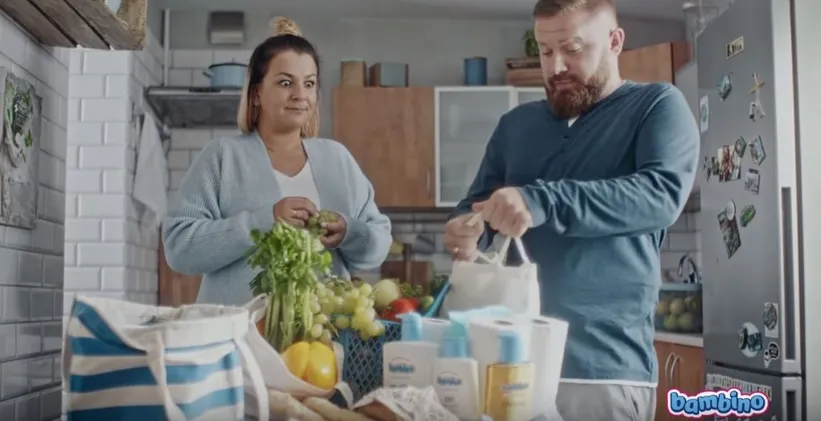
Bambino advertisement
The image of the male body in advertising reveals the same problem that women faced earlier. More and more articles are appearing about how destructive the impact of displaying perfect, retouched silhouettes is on self-esteem. On the internet, initiatives against body-shaming among men are growing. An example is the post of Sam Smith, who showed himself shirtless — far from advertising adonises and clearly at peace with it.
Worldwide, the number of commercials redefining the roles of fathers is also growing. The Pampers advertisement, showing famous artists as affectionate dads, proves that a modern man can combine work, passions and active fatherhood – changing diapers or showing affection does not diminish his masculinity.
A counterargument to the previous image of masculinity was also the latest Gillette campaign . The brand, which for years presented a stereotypically "ideal" man – muscular, perfectly shaved, accompanied by adoring women – this time tempted a strong message: many negative male behaviors persist because other men do not react to them. The advertisement touched on the topics of violence, sexism and the "boys will be boys" rule, and provoked strong reactions – some praised the courage of the brand, others found the message accusing men.
These are only advertisements…?
It may seem that advertisements are a trifle, but their impact on society can be profound. By promoting unrealistic advertising models, people set impossible demands for themselves – they focus on insignificant details, forget about their emotions, become self-critical and depressed. This results in a decline in self-confidence in men, complexes, and even more serious mental health problems – this is only part of the consequences of the media-created gender image.
Fortunately, we are observing a gradual reversal of negative trends: small but significant changes are already taking place. It is worth believing that more and more brands will follow this path and advertising will play a constructive role in shaping healthier perceptions of masculinity.